 +919170467985
The Mooladhara Chakra, also known as the Root Chakra, is the first and most fundamental energy center in the human subtle system. Derived from the Sanskrit words “Moola” meaning root and “Adhara” meaning base or support, it forms the very foundation of human existence—physically, emotionally, and spiritually. Located at the base of the spine near the tailbone, this chakra governs our sense of security, grounding, and connection with the Earth.
In traditional yogic understanding, the Mooladhara Chakra is associated with survival instincts, stability, and life force energy. However, in Sahaja Yoga, its significance extends far beyond basic survival. It is considered the seat of innocence, purity, and innate wisdom, making it essential not only for physical balance but also for true spiritual awakening.
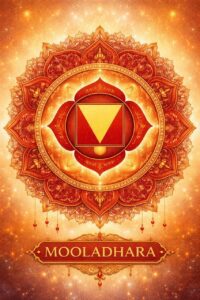
Symbolism and Meaning
The basis of human consciousness is depicted by the lotus which has four petals which symbolize the Mooladhara Chakra. The square is put in the middle and it denotes stability, structure and the Earth element. The square has an inverted triangle that represents grounding energy and attachment to the physical world. The main color with this chakra is red which signifies vitality, strength and life force energy. It is also associated with the bija mantra, Lam, which is applied during meditation to energize and harmonize it.

Role in Physical and Emotional Balance
This chakra is essential in ensuring physical and emotional stability. It controls the legs and bones, as well as the lower part of the body, giving it strength and support. It has an emotional impact on safety, trust and belonging. Balanced Mooladhara Chakra enables people to be relaxed, assured and stable in their life.
Evidence of Obstruction and Imbalance
In the event of blockage of the Root Chakra, the result can be fear, anxiety, insecurity and absence of confidence. Physical symptoms may comprise of fatigue, lower back pain, and instability. Excessive activity can lead to aggression or too much concern with material security.
What the Root Chakra Really Feels Like
Think of the Mooladhara Chakra—the Root Chakra—as your body’s basement. It sits at the very base of your spine, and it holds up everything else in your life. This isn’t some “woo-woo” concept; it’s the part of you that wants to feel safe, fed, and stable. When it’s working well, you just feel okay in your own skin. You’re not second-guessing your security or constantly bracing for something bad to happen.
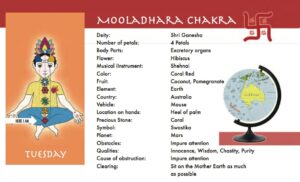
Why Earth Energy Matters
This chakra is tied to the Earth element. And not in a poetic, distant way—in a very real, under your feet kind of way. The Earth holds you up without asking for anything in return. That’s what a balanced Root Chakra does too: it quietly supports you, so you don’t have to fight for a sense of belonging or safety.
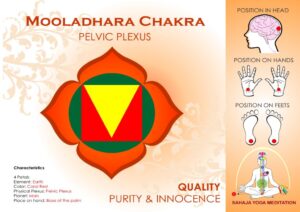
Small Ways to Come Back Home
You don’t need to sit on a mountaintop to heal this. Try:
- Walking barefoot on grass or dirt (yes, really—it helps).
- Chanting “Lam” softly, even just to yourself.
- Or simply sitting still for two minutes, feeling your feet on the floor.
Mooladhara Chakra in Sahaja Yoga – The Seat of Innocence
Where It All Begins
In Sahaja Yoga, the Mooladhara Chakra isn’t just another energy center. It’s the very foundation of your subtle system—like the roots of a great tree. It sits right below the Kundalini at the base of your spine, quietly holding everything up. What’s beautiful about this chakra is that it doesn’t cross the central channel like others do. Instead, it simply supports. It gives you grounding, balance, and most importantly, purity. Without a clean Mooladhara, the Kundalini can’t rise smoothly—it’s that essential.
What Shri Mataji Taught Us About Innocence
Shri Mataji Nirmala Devi often said that the Mooladhara Chakra is the seat of innocence. And by innocence, she didn’t mean being naive or childish. She meant that original, untouched quality you were born with—the one that knows how to simply be, without ego, without games, without pretense.
She used to say that this innocence can never be destroyed. It can only get covered up—by stress, by conditioning, by the world’s heaviness. But through Sahaja Yoga meditation, that purity naturally comes back. Not by force. Just by letting it resurface, like clear water rising through mud.
Why Innocence Is Real Strength
In today’s world, innocence is often mistaken for weakness. But in Sahaja Yoga, it’s exactly the opposite. Innocence is a powerful state of awareness. When your Mooladhara is pure, you stop overthinking. You stop assuming the worst in people. You start seeing things as they are—without the fog of your own baggage. And that brings a deep, quiet joy. A sense of security that doesn’t depend on anything outside of you.
The Deities Who Watch Over It
The Mooladhara is governed by Shri Ganesha—the elephant-headed deity who represents pure wisdom, childlike joy, and fearlessness. He removes obstacles, not by fighting them, but by simply being so innocent that obstacles lose their power. Alongside Him is Shri Kartikeya, who adds protection and courage. Together, they guard the Kundalini energy and keep the root chakra balanced and safe.

What Happens During Kundalini Awakening
When the Mooladhara is pure, the Kundalini rises like a gentle, steady river. No jerks. No disturbances. Just a smooth, natural flow upward. And as it rises, you begin to experience thoughtless awareness—that beautiful state where your mind is awake but quiet. Alert but peaceful. It’s not emptiness. It’s full without noise.
Simple Sahaja Yoga Practices to Balance the Root Chakra
You don’t need anything complicated. Here are a few gentle practices:
- Meditation – Just sit with yourself for a few minutes each day.
- Foot soaking – Soak your feet in slightly salted warm water. It’s surprisingly effective for clearing the Mooladhara.
- Pure attention – Try to look at the world without judgment, even for a few moments.
- Connect with the Earth – Walk barefoot, garden, or simply sit on the ground.
These small habits slowly bring back that innocence you never really lost. And with it comes a kind of peace that feels like coming home.

Mooladhara Chakra and Mandala Art – Finding Grounding Through Design
The Shapes That Hold Us
There’s something quietly powerful about sacred geometry. The Mooladhara Chakra speaks through shapes that feel solid and true: a stable square, a downward-pointing triangle, and a four-petaled lotus. These aren’t just pretty patterns. They’re visual reminders of structure, safety, and foundation. When you arrange them in a mandala—balanced, repeating, harmonious—you’re not just making art. You’re drawing stability back into your own energy.
Why Red, Black, and Earth Tones?
The Root Chakra’s main color is red—not an aggressive red, but the warm, life-giving red of healthy blood, rich soil, or a glowing sunset. It stands for strength, vitality, and feeling secure in your own body. Then come the earthy tones: browns, deep oranges, charcoal blacks. These colors don’t shout. They hold. Like dirt under your feet after rain. When you use them in a mandala, you’re wrapping yourself in a visual hug of grounding energy.
How to Make Your Own Mooladhara Mandala
You don’t need to be an artist. Really.
Start simple:
- Draw a small square or circle in the center. That’s your anchor.
- Inside or around it, place a triangle pointing downward. This represents energy rooting into the Earth.
- Build outward with symmetrical patterns—repeating petals, dots, or curved lines. Let it grow like a flower.
- Use red as your base color. Layer in earthy browns or deep blacks for depth.
- Add four distinct petal shapes somewhere in the design to honor the lotus of Mooladhara.
Let your hand move slowly. There’s no rush. The repetition itself is the meditation.
Why Coloring or Drawing a Mandala Calms You
Have you ever noticed how your mind gets quiet when you’re focused on a small, repetitive task? That’s exactly what happens with chakra mandala art. As you draw or color, your breathing slows. Your thoughts stop racing. You’re not trying to “fix” anything—you’re just present. And in that presence, the Root Chakra softens and opens. You feel more here. Less scattered.
Using Mandala Art as a Healing Tool
Think of your mandala as a gentle mirror for your inner state. When you feel anxious or ungrounded, sit with your Mooladhara mandala for five minutes. Notice the red. Trace the square with your finger. Breathe. You’re not forcing healing; you’re inviting it.
Over time, this simple practice can:
- Release built-up stress
- Lift heavy or negative moods
- Reconnect you with a sense of safety and belonging
And the best part? The Earth is always beneath you. The mandala just helps you remember that.
Mooladhara Chakra – Where Spiritual Awakening Actually Begins
The Starting Point of Kundalini
Deep inside each of us, there’s a gentle, sleeping energy. That’s the Kundalini, and she rests at the base of the spine, right in the space of the Mooladhara Chakra. Think of this chakra as the doorway. Not loud or dramatic—just quietly waiting. When the Root Chakra is clean and balanced, that energy wakes up naturally, like a stream finding its way downhill. It rises slowly, without forcing, carrying you toward something bigger: clearer awareness, inner calm, and a shift you can feel in your bones.
But if the Mooladhara is blocked or weak? That energy stays asleep. Or worse, it stirs unevenly. That’s why this first chakra matters so much.
Why You Can’t Skip the Root
A lot of people want spiritual growth fast—they chase visions, insights, big flashes of light. But real awakening doesn’t work that way. It starts low. Literally.
The Mooladhara is the first step because it’s the foundation for everything else. You wouldn’t build a house without a basement, right? Same here. This chakra gives you the grounding you need so that when higher awareness comes, you don’t get dizzy or lost. It keeps you connected to your body, to your daily life, to the floor beneath your feet. Without that, spiritual experiences can feel scary instead of beautiful.
Conclusion
In Sahaja Yoga, the Mooladhara Chakra is not simply concerned with survival, but it is the seat of innocence and divine wisdom. True spiritual development and awakening of the Kundalini needs its purity as taught by Shri Mataji Nirmala Devi.
Deep inner stability, joy and union with the divine may be achieved by nurturing this chakra through meditation, pure living and creative process such as the mandala art.
The path of spirituality starts at the origin-and when the origin is good, then the whole tree of life will have a thriving life.