 +919170467985
The Rigveda stands as one of the oldest and most sacred texts of humanity, preserving the foundational spiritual, ritual, and philosophical wisdom of ancient India. For students and seekers, a fundamental question arises: how many Mandalas are there in the Rigveda? This inquiry opens the door to understanding the text’s very architecture. The answer is that the Rigveda is systematically organized into ten Mandalas. Each Mandala is a curated collection of hymns (Suktas) and sacred verses (Mantras) dedicated to various deities.In total, these ten Mandalas encompass 1,028 Suktas and more than 10,500 Mantras, establishing the Rigveda as a vast, intricate, and symbolically rich foundation of Hindu scripture and world spirituality. This careful division reveals the methodical organization by ancient seers and embodies the profound depth and enduring continuity of the Vedic tradition.
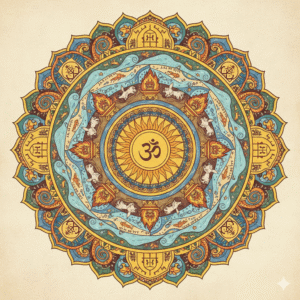
What Is a Mandala in the Rigvedic Context?
In the Rigveda, the word “Mandala” doesn’t mean the round, patterned art we think of now. Instead, it means a “book” or a “circle” of sacred songs and poems.
Think of it like this:
- The whole Rigveda is like one big book of ancient wisdom.
- It is divided into 10 main sections, called Mandalas.
- Each Mandala is made up of many hymns, called Sūktas.
- And each hymn is made of many verses, called Mantrās.
So, you could say the Rigveda contains 10 Mandalas, which hold about 1,028 hymns, which together have over 10,000 verses.
The most common version we read today is called the Śākala version. Each of the ten Mandalas is usually named after the main sage who is said to have received its hymns, or sometimes after a special feature found inside
Mandala 1 – Śatṛcina and Madhyamā Mandala
The first book of the Rigveda, Mandala 1, is special because it is divided into two clear parts.
- The First Part (Shatrichina): The first 51 hymns are grouped together. This section is named “Shatrichina,” which refers to the fact that these specific hymns contain exactly 100 verses. This shows the precise, counted nature of the ancient hymns.
- The Second Part (Madhyama): The rest of the hymns in this book (from number 52 to 191) make up the “Madhyama” or “middle” section. These hymns are from various sages and are considered medium in length—not too short and not too long.
Mandala 2 – Gṛtsamada Mandala
This section of the Rigveda is distinguished by its exclusive association with Sage Gṛtsamada and his descendants, making it one of the most authorially cohesive parts of the text. Its key characteristics are:
- Singular Authorship: Every one of its 43 hymns is credited to the lineage of Sage Gṛtsamada. This unified origin provides a consistent voice and devotional perspective throughout the entire collection.
- Foundational Hymns: It preserves several invocations of great historical and theological significance. Notably, it contains an early verse that later tradition identifies as dedicated to Gaṇeśa, as well as a major hymn devoted to the deity Rudra, which includes references to Kumāra (Skanda).
- Thematic Focus: The content emphasizes disciplined ritual precision, structured worship, and focused devotion. This reflects the text’s role in formalizing and transmitting specific liturgical practices within the Vedic tradition.
Mandala 3 – The Viśvāmitra Mandala
This section of the Rigveda is named for the great sage Viśvāmitra and his family. It is one of the most important and respected parts of the entire text. Here’s why:
- Revealed by a Legendary Sage: All 62 hymns in this section were revealed by Sage Viśvāmitra and his descendants, giving it a powerful and unified spiritual voice.
- Home of the Gāyatrī Mantra: Mandala 3 contains the most sacred and widely chanted mantra in Hinduism—the Gāyatrī Mantra. This single verse is considered the essence of Vedic wisdom and is a cornerstone of daily prayer and meditation for millions.
- Focus on Spiritual Guidance: It also includes a special mantra for honoring one’s teacher (Guru), highlighting this section’s deep connection to spiritual learning, tradition, and the passing of sacred knowledge from master to student.
Mandala 4 – The Vāmadeva Mandala
This section is named after the sage Vāmadeva and his family. Its main features include:
- A Family’s Devotion: All 58 hymns in this book are credited to Sage Vāmadeva and his descendants, continuing the tradition of family-based spiritual composition.
- Hymns of Power and Inspiration: The verses here focus on praising the gods Agni and Indra, celebrating themes of strength, wisdom, and divine insight that fuels human action.
- Source of the Kumāra Sūktam: This book is the original source of the Kumāra Sūktam, a famous hymn associated with youthful divine energy and courage.
Mandala 5 – The Aitareya Mandala
Attributed to the sage Atri and his lineage, this book has a strong practical and devotional focus.
- The Atri Family Tradition: Its 87 hymns are revealed by Sage Atri and his descendants, known for their deep piety.
- Essential for Daily Rituals: This Mandala is vital for daily worship. Its fifth hymn is traditionally recited before performing one’s obligatory rites, stressing discipline and spiritual readiness.
- Guidance for Daily Life: The hymns here balance deep devotion with clear, practical guidance, serving as a spiritual manual for both priests and laypersons managing ritual and household duties.
Mandala 6 – The Bharadvāja Mandala
Named for the sage Bharadvāja and his family, this book is known for its strength and practicality.
- A Family’s Strength: All 75 hymns belong to Sage Bharadvāja and his lineage, known for their discipline and fortitude.
- Hymns of Power and Protection: It features powerful praises to Agni and Soma-Rudra. Uniquely, it also includes mantras for blessing actual weapons and armor—like chariots, bows, and arrows—showing how spirituality was woven into the duty of protection.
- Spiritual Armor: The final hymn is a ritual chant for empowering a warrior’s gear, highlighting the Vedic ideal of combining inner spiritual strength with outer responsibility.
Mandala 7 – The Vasiṣṭha Mandala
This important section is attributed to the revered sage Vasiṣṭha.
- The Voice of a Great Sage: Its 104 hymns are primarily the revelations of Sage Vasiṣṭha, a figure of supreme spiritual authority.
- Hymns of Cosmic Forces: It contains powerful invocations to Rudra, Agni, and the storm gods (Maruts), often using the imagery of cosmic battles to symbolize inner and social conflicts.
- Home of a Healing Mantra: This book includes the famous Tryambakaṃ mantra, a sacred chant devoted to Rudra for healing, long life, and spiritual refuge, making it central to Vedic practices for well-being.
Mandala 8 – The Prāgātha Mandala
This section is known for its collective authorship and rich variety.
- Many Voices: Unlike earlier books, its hymns come from several sage families, including the Kāṇvas, Aṅgiras, Atris, and Bharadvājas, giving it a diverse character.
- A Treasury of Poetry: It is valued for preserving a wide range of ancient poetic rhythms and styles, acting as a record of early creative and ritual experimentation in the Vedic tradition.
Mandala 9 – The Soma-Pavamāna Mandala
This book is unique and entirely focused on one theme.
- Dedicated to Soma: Every one of its 114 hymns is dedicated exclusively to Soma, the sacred ritual beverage representing purification and divine ecstasy.
- Central to Rituals: These hymns are essential in both domestic (Gṛhya) and elaborate public (Soma) ceremonies. Soma is praised as the purifying, life-giving force that inspires even the major gods like Indra and Agni.
Mandala 10 – The Book of Great Hymns
The final book is the longest and most philosophical.
- Two Main Parts: It is divided into the Mahā Sūktas (Great Hymns) and the Kṣudra Sūktas (Smaller Hymns), covering a vast range of topics.
- Home of Profound Philosophy: It contains some of Rigveda’s most famous and deep hymns, which explore fundamental questions about the origin of the universe, the nature of reality, cosmic order, and divine consciousness.
Frequently Asked Question (FAQ)
1. How many Mandalas are there in the Rigveda and how are they structured?
The Rigveda is structured into ten Mandalas (books). Each Mandala contains a collection of hymns called Sūktas, and each Sūkta is made up of individual sacred verses known as Mantras.
2. What is the spiritual significance of the ten Mandalas of the Rigveda?
The ten Mandalas form a sacred map of Vedic wisdom, preserving teachings on cosmology, ethics, ritual practice, and devotion. They channel reverence toward divine forces—such as Agni, Indra, and Soma—guiding spiritual practice and philosophical inquiry.
3. Which sages are associated with different Mandalas in the Rigveda?
Each Mandala is traditionally linked to specific sage lineages. Key figures include Gṛtsamada (Mandala 2), Viśvāmitra (Mandala 3), Vāmadeva (Mandala 4), Atri (Mandala 5), Bharadvāja (Mandala 6), and Vasiṣṭha (Mandala 7), among others.
4. What types of hymns (Sūktas) are found in each Mandala of the Rigveda?
The Sūktas encompass devotional praise, ritual invocations, philosophical reflections, healing mantras, and symbolic narratives—all dedicated to various Vedic deities such as Agni, Indra, Soma, Rudra, and the Maruts.
5. Why is the division of the Rigveda into ten Mandalas important in Vedic tradition?
This division organizes a vast body of sacred knowledge, supports precise oral transmission across generations, and maintains the ritual, theological, and spiritual coherence essential to Vedic tradition and practice.