 +919170467985
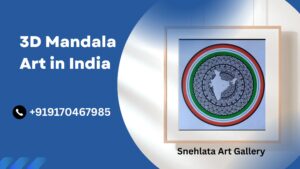
3D Mandala Art in India welcomes us into a time of greater mindfulness and spiritual connection. It skillfully blends ancient wisdom with modern expression. As an artist who works with mandalas and sacred geometry, I see 2026 as a turning point. Mandala art is moving beyond simple decoration to become a purposeful and transformative practice.
Through my work at Snehlata Art Gallery, I see firsthand how these three-dimensional creations are changing spaces, enriching emotions, and deepening spiritual awareness across India.
Ancient Roots Guiding the Future
The Sanskrit tradition forms the foundation of mandala art in India, where the word “Mandala” itself means “sacred center” or “circle of energy.” For centuries, spiritual practitioners and artisans have used mandalas in meditation, temple architecture, and sacred rituals.
In 2026, these ancient roots now guide a new generation of artists. While we preserve the spiritual essence, our creative expression evolves. We build layered, dimensional forms that honor tradition while embracing innovation.
Understanding 3D Mandala Art
3D Mandala Art is a modern way to create mandala designs with real depth. It works by using careful shading with a black pencil and building up precise layers. This gives the artwork a realistic three-dimensional look that seems to stand out from the page.
The style mixes creativity with balance and symmetry. This makes it both beautiful to look at and meaningful to experience.
Today, the focus of artists has grown more refined. With 3D Mandala Art in India , the practice is about patience, accurate shading, and thoughtful design. The result is artwork that feels calm, elegant, and visually strong.
Future of 3D Mandala Art in India
3D Mandala Art in India holds a strong and meaningful future. Artists combine traditional patterns with modern techniques to build layered, three-dimensional designs. This art form attracts people by promoting calm, balance, and spiritual connection.
With the rise of mindfulness and handmade art appreciation, galleries, exhibitions, and digital platforms now actively support this art. Artists also embrace new tools and materials to expand their creativity. As awareness grows, 3D Mandala Art will continue to grow as an important part of India’s contemporary and spiritual art scene.
Why 3D Mandala Art Is Gaining Popularity in India
India has never underestimated art that has some meaning and discipline. This cultural background helps in its increasing acceptance among the collection and art lovers in 3D Mandala Art in India.
I believe this growth will occur due to:
Individuals need tranquility and concentration in the busy life.
Habitual art is better than mass production of decorations.
Artists currently teach viewers online.
Customers would like individualized and significant paintings.
The increasing consciousness makes the 3D Mandala Art an effective creative direction in India.
The 3D Mandala Art in India and Interior Spaces.
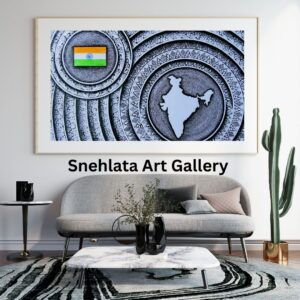
In India, the 3D Mandala works of interior design will gain popularity among interior designers in residential and commercial buildings. I frequently observe that these pieces of art are applied as statement pieces to add balance and dimension to the interiors.
The artworks created in India with 3D Mandala Art are effective in:
Living rooms and personal studios.
Corporate offices and offices.
Y0ga, health, and fitness facilities.
Luxury and modern interiors
The stratified design is not too heavy handed.
My Snehlata Art Gallery Artistic Approach.
In Snehlata Art Gallery, I lay emphasis on producing 3D Mandala paintings and 3D Mandala and sacred geometry art. Being a 3D Mandala artist, I can make every single piece of art clear and purposeful, starting with an idea and finishing with it.
Trust and expertise is important in 3D Mandala Art in India. I maintain this by:
High quality of materials used.
Using a systematic innovative process.
Transfer of knowledge in online classes.
Professional course offerings in my web site.
This strategy will assist me in gaining trust and becoming a genuine learner and collector.
Learning 3D Mandala Art
There has been an increased opportunity to learn. Online education takes advantage of artists and learners like never before in 3D Mandala Art in India.
I offer:
Online basic and advanced classes.
Formal courses on my site.
Technique and practice directed lessons.
The learning options allow the students to build up the skills with appropriate guidance and not by trial and error.
Frequently Asked Questions (FAQ)
Q1. Why will 3D Mandala Art matter in 2026?
A. The significance of 3D Mandala Art is that it has depth, focus and intentional creativity that people are finding relevant in contemporary lifestyles.
Q2. Is it possible to learn 3D Mandala Art using the Internet?
A. Yes, novices can study in organized internet classes and courses which will teach them step by step with appropriate methods.
Q3. What is 3D Mandala Art applied to that, indoor?
A. It is applied on walls, centerpieces of decor, and relaxing scenery in homes, offices, and the wellness environments.
Q4. Professional 3D Mandala Art in India: Where can I study?
A. Artist-led courses such as Snehlata Art Gallery, offer online courses in the field of professional learning.
Q5. Is handmade mandala art still valuable ?
A. absolutely. Handmade art carries a unique intention and energy that machines cannot replicate.
3D Mandala Art in India is an expression of depth, order, and contemporary art. Education, authenticity, and conscious practice are ways through which I as an artist see this art form developing. My ongoing involvement in this emerging space involves my contributions to this space, through Snehlata Art Gallery, which is to create, teach and exchange professional 3D Mandala Art that relates depth to purpose.